
OEE and machine evidence
The evidence behind OEE, before the score.
Astara measures the parts of OEE a machine can prove: how long it ran, where it lost time, how fast it produced and how output compared with the plan. It does not publish a single OEE percentage, and this page explains why.
The trouble with one number
An OEE score is only as good as the three numbers under it.
Overall equipment effectiveness multiplies availability, performance and quality. If any one of them is estimated, typed in at the end of a shift or built on an ideal rate nobody agrees on, the result looks precise and means very little.
Astara starts from the other end. It records what the machine itself reports and shows each measure on its own, so your team can see what is driving the loss instead of arguing about the score.
OEE, factor by factor
What Astara measures.
Each OEE factor needs its own evidence. Here is what Astara captures for each one, and where it stops.
Availability: running time
Running, idle, stopped and faulted time is calculated from machine state changes, for any period you choose.
Availability: lost time
Stops are explained by the machine's alarm codes and by the downtime reasons your supervisors assign.
Performance: production rate
Rate is measured over running time and broken down by product, so slow running is visible separately from stops.
Performance: plan against actual
Planners enter expected production and Astara reports attainment for the days that have a plan.
Quality: not measured
Astara reads a production total from the machine. It does not count rejects or scrap, so it makes no quality claim.
Unknown time stays unknown
Time when a machine or gateway was not reporting is shown as unknown rather than folded into a percentage.
Why no single score
Honest inputs. Useful answers.
Astara will not show an OEE figure until availability, performance and quality inputs are all defined and trustworthy. Until then, the measures it does show are ones you can act on directly.
- Time allocation by machine state for any period
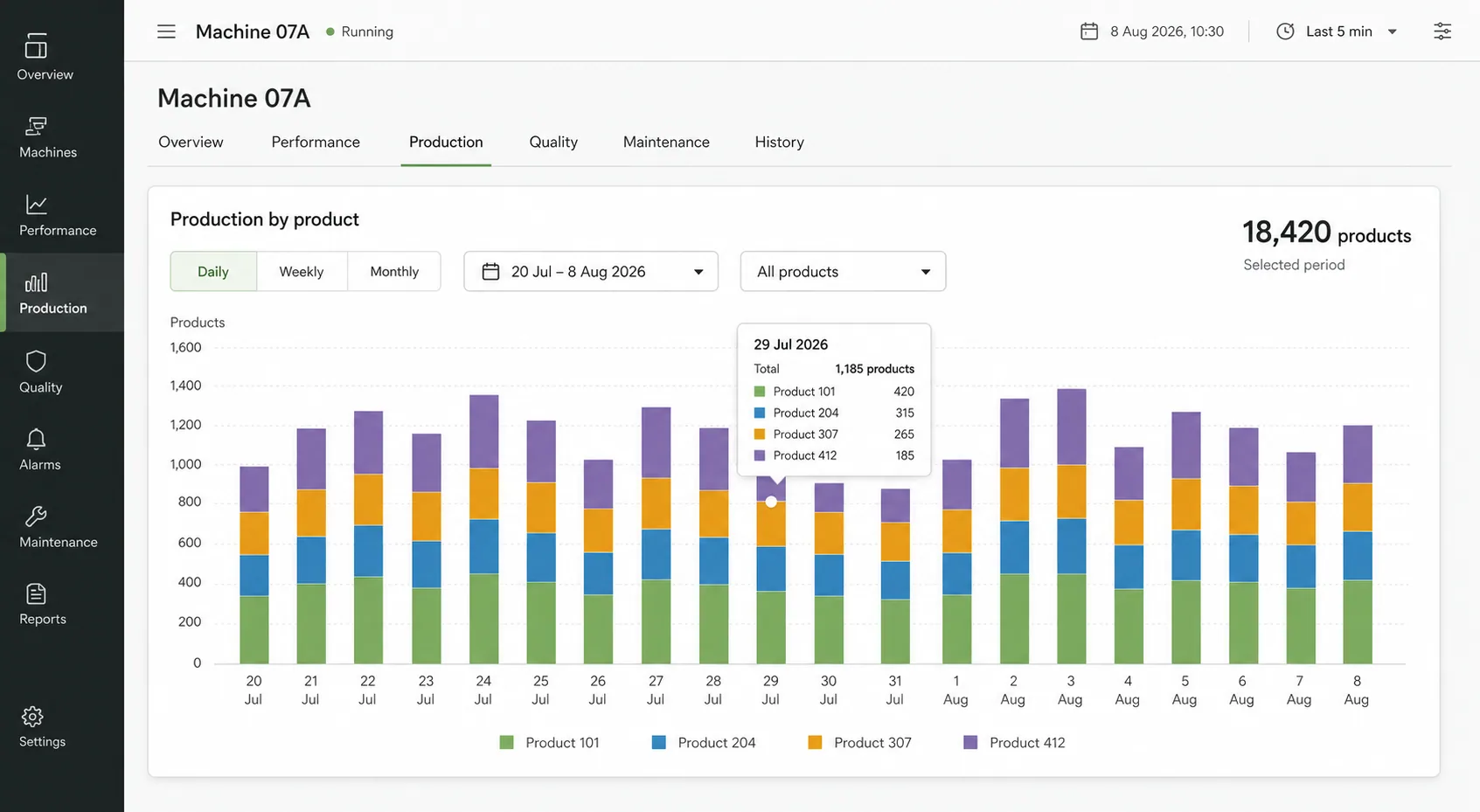
- Production rate and totals by product
- Plan attainment for planned days
- Current period compared with the previous one
Common questions
OEE, answered.
Does Astara calculate OEE?
Not as a single percentage. Astara measures the availability and performance evidence behind OEE, such as running time, lost time, production rate and output against plan, and shows each one separately. It does not measure quality, so it does not publish an OEE score.
What is OEE?
Overall equipment effectiveness is availability multiplied by performance multiplied by quality. Availability is the share of planned time the machine actually ran, performance is how fast it ran compared with its ideal rate, and quality is the share of output that was good.
Can we calculate OEE ourselves from Astara's data?
Yes. Astara gives you measured running time and production counts by product. Combined with your own planned production time, ideal rates and reject counts, those are the inputs you need to calculate OEE in a way your team agrees on.
Why start with downtime instead of OEE?
For most small and mid-sized manufacturers the largest and most fixable loss is unplanned stopped time. Measuring it accurately gives the team something specific to fix, which an overall score on its own does not.
Features
More from Astara
How it works
From a PLC signal to a decision-ready shift.
Read moreThe workspace
Dashboards, downtime reasons, plans and reports.
Read moreDowntime tracking
See where operating time went, and why.
Read moreMachine monitoring
Live state and production across every site.
Read morePLC data collection
Read-only OPC UA collection at the edge.
Read moreFood & packaging
Production visibility for food and packaging lines.
Read moreStart with one machine. Make the next shift easier to understand.
Bring a machine, a spreadsheet or simply a question. We'll show you what a clearer operational story can look like.
Book a demo