SCADA vs machine monitoring: collecting production data
SCADA and machine monitoring software both collect PLC data, but for different jobs. Learn the difference, when you need each, and how to collect production data without a SCADA project.
When manufacturers start looking for a way to collect production data from their machines, the conversation often turns to SCADA. SCADA is powerful, proven and found in many plants. It is also built for a different job than tracking production and downtime. This article explains the difference between SCADA and machine monitoring software, and how to collect the production data you need without starting a SCADA project.
What SCADA is for
SCADA (supervisory control and data acquisition) is built to operate a process. It gives operators screens (HMIs) to see and control equipment, raises alarms in real time, and often writes setpoints and commands back to PLCs. It shines in continuous processes, utilities and plants where centralised control matters: water treatment, power, large process lines.
That brings requirements: engineering of tags and screens, a server on site, licences per tag or client, and careful change control, because SCADA can change how equipment behaves.
What machine monitoring is for
Machine monitoring software is built to understand production after it happens and while it happens. It reads a small number of signals from each machine and turns them into a record of output, machine states, downtime and faults that management, supervisors and maintenance can act on.
- It reads; it never controls. A monitoring gateway subscribes to signals and does not write values or call methods on the PLC.
- It needs only a few signals per machine: machine state, product code, a production total, and optionally a fault code.
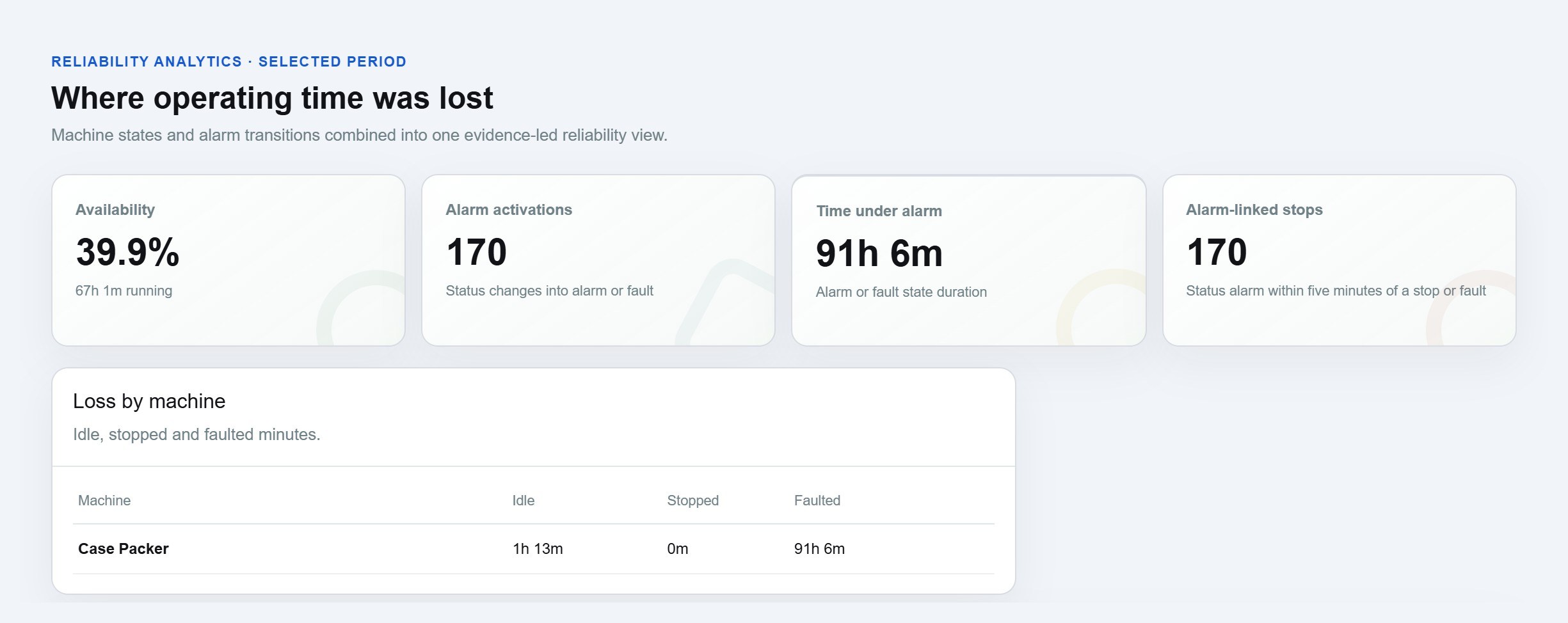
- It aggregates and reports: time by state, output by product, faults by lost time, shift and weekly reports.
- It is usually delivered from the cloud, so there is no server to maintain on site.
Side by side
- Purpose: SCADA operates the process; monitoring measures production and downtime.
- Access to PLCs: SCADA reads and writes; monitoring is read-only.
- Signals: SCADA uses hundreds to thousands of tags; monitoring uses a handful per machine.
- Users: SCADA serves control-room operators; monitoring serves supervisors, planners, maintenance and managers on any device.
- Set-up: SCADA needs an engineering project; monitoring needs a gateway and a short configuration.
Do you need both?
Many plants have SCADA on some processes and nothing on their packaging lines. Others have SCADA but find that getting a weekly downtime report out of it means exports, spreadsheets and a lot of someone's Friday afternoon. The two complement each other. SCADA keeps running the process, and monitoring answers “how much did we make, how much time did we lose, and why?”
If your plant doesn't run SCADA, you don't need to install it to get production data. A read-only machine monitoring gateway connects straight to the PLCs.
How data collection works without SCADA
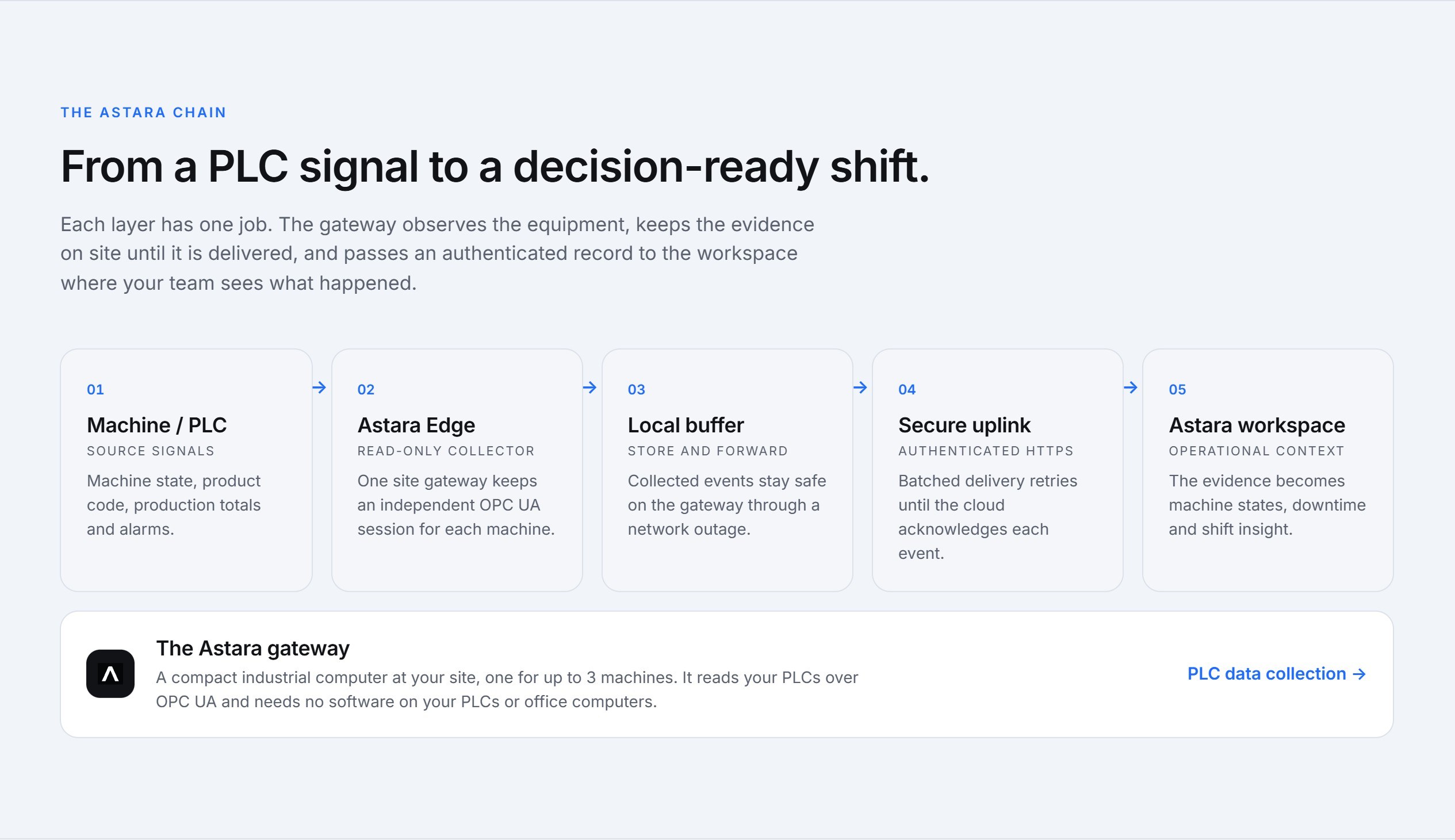
- OPC UA on the PLC. Most modern controllers include an OPC UA server, or one can be added with a firmware option or a small protocol gateway. Your controls engineer exposes the few signals monitoring needs.
- A gateway on the site network. A small industrial computer opens one OPC UA session per machine, reads the signals and subscribes to changes.
- A durable local queue. Every event is written to disk before it is sent, so an internet outage loses nothing. Events are deleted only after the cloud confirms they arrived.
- An authenticated uplink. The gateway sends batches over HTTPS to the cloud, where they become production, state and fault records.
- Honest gaps. If a machine or the gateway can't be reached, that time is shown as unknown or offline, never filled in as running or stopped.
This is how Astara's PLC data collection works. How Astara works walks through each step from PLC signal to shift report.
Questions to ask your controls engineer
- Does each PLC have an OPC UA server, or can one be enabled?
- Which tags hold machine state, product code and the production counter?
- Is there a fault or alarm number we can read?
- Can the gateway reach the PLCs on the site network, and the internet over HTTPS?
If the answers are yes, you can be collecting production data within days rather than months. Talk to us about connecting your first machine.